

Identify critical vulnerabilities before they are exploited or become expensive operational problems.
Service Details
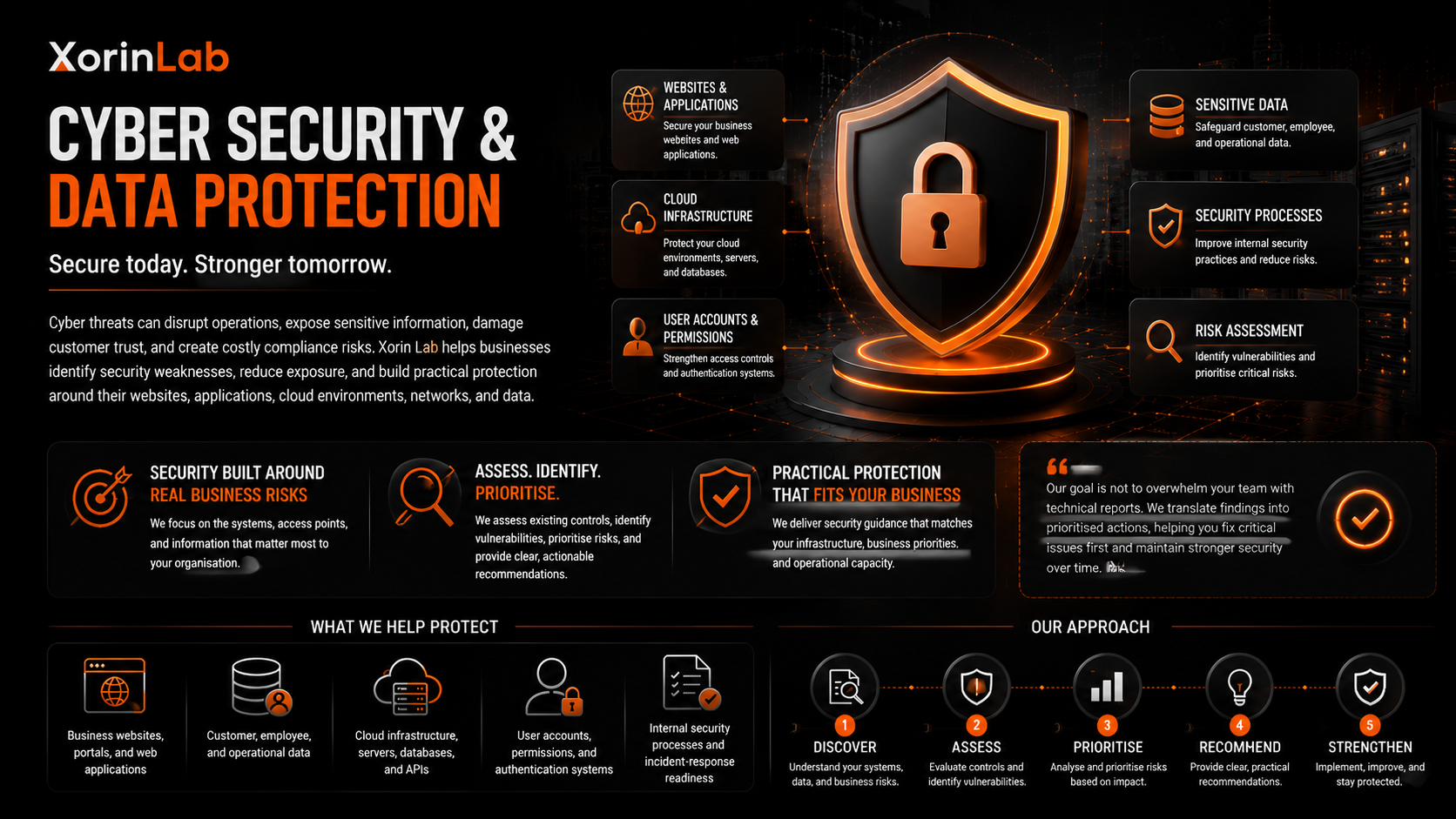
Cyber Security & Data Protection
Cyber threats can disrupt operations, expose sensitive information, damage customer trust, and create costly compliance risks. Xorin Lab helps businesses identify security weaknesses, reduce exposure, and build practical protection around their websites, applications, cloud environments, networks, and data.
Security built around real business risks
Our Cyber Security & Data Protection service focuses on the systems, access points, and information that matter most to your organisation. We assess existing controls, identify vulnerabilities, prioritise risks, and provide clear recommendations your technical and management teams can act on.
Whether you are launching a new digital product, strengthening an existing platform, preparing for a security review, or improving internal data-handling practices, we deliver security guidance that fits your infrastructure, business priorities, and operational capacity.
What we help protect
- Business websites, portals, and web applications
- Customer, employee, and operational data
- Cloud infrastructure, servers, databases, and APIs
- User accounts, permissions, and authentication systems
- Internal security processes and incident-response readiness
Our goal is not to overwhelm your team with technical reports. We translate findings into prioritised actions, helping you fix critical issues first and maintain stronger security over time.
What We Provide
Security Risk Assessment
A structured review of your systems, data flows, access controls, and operational practices to identify and prioritise security risks.
Vulnerability Assessment
Technical testing to uncover exposed services, insecure configurations, outdated components, and application-level weaknesses.
Web Application Security Review
A focused assessment of authentication, authorisation, input handling, APIs, sessions, and other security-sensitive application areas.
Data Protection Planning
Practical controls for collecting, storing, accessing, transferring, retaining, and securely removing sensitive business and customer data.
Access Control Review
Evaluation of user roles, permissions, privileged access, password practices, and account lifecycle processes.
Security Policies and Guidance
Clear security policies, technical recommendations, and staff guidance aligned with your organisation's actual workflows.
Feature Points
Receive prioritised recommendations based on risk, business impact, and remediation effort.
Strengthen protection across applications, infrastructure, user access, and sensitive data.
Improve security readiness without introducing unnecessary tools or complicated processes.
Give technical and non-technical stakeholders a clear view of security risks and next steps.
Solutions We Deliver
Website and Web Application Security
Security reviews for business websites, customer portals, dashboards, SaaS platforms, and custom web applications that handle accounts, payments, documents, or sensitive information.
Cloud and Server Security
Configuration reviews and security recommendations for cloud environments, virtual servers, databases, storage services, deployment pipelines, and administrative access.
API and Authentication Security
Assessment of API exposure, token handling, session controls, login systems, role-based permissions, and protection against unauthorised access.
Business Data Protection
A practical framework for protecting customer records, employee information, documents, credentials, backups, and other sensitive business data.
Security Readiness and Remediation
Actionable support for businesses preparing for a launch, client security review, compliance discussion, infrastructure migration, or remediation project.
Ongoing Security Improvement
Periodic reviews, vulnerability follow-ups, security recommendations, and technical guidance for organisations that need continuous risk reduction.
Our Process
1
Discovery and Scope
We identify the systems, applications, data, users, business risks, and technical boundaries that need to be reviewed.
2
Security Assessment
Our team evaluates configurations, access controls, application behaviour, exposed services, dependencies, and relevant security practices.
3
Risk Analysis
We validate findings and classify them by severity, likelihood, potential business impact, and urgency.
4
Recommendations and Reporting
You receive a clear report containing evidence, affected areas, risk explanations, and practical remediation guidance.
5
Remediation Support
Xorin Lab works with your internal team or development partner to clarify findings and support the implementation of appropriate fixes.
6
Verification and Follow-Up
Where included in the engagement, we review completed fixes, confirm whether identified issues have been resolved, and highlight remaining risks.
Key Features
- Risk-based security assessments
- Web application vulnerability reviews
- Cloud and server configuration checks
- API and authentication security analysis
- Role and permission assessment
- Sensitive data protection planning
- Prioritised remediation guidance
- Clear technical reporting
Why Choose Us
Practical, Prioritised Guidance
We separate urgent security risks from lower-priority improvements, so your team knows what to address first and why.
Business-Aware Security
Our recommendations consider your operations, technical environment, available resources, and the real impact of each risk.
Clear Communication
Xorin Lab explains technical findings in straightforward language while providing enough detail for developers and system administrators.
End-to-End Perspective
We examine how applications, infrastructure, user access, and data-handling practices work together rather than reviewing them in isolation.
Responsible Security Practices
Assessments are conducted within an agreed scope, with careful handling of credentials, findings, and sensitive business information.
Frequently Asked Questions
- What types of businesses need cyber security services?Any organisation that operates a website, stores customer or employee information, uses cloud services, manages online accounts, or depends on digital systems can benefit from a security assessment. The scope can be adjusted for startups, growing businesses, agencies, educational organisations, and established companies.
- What is included in a security assessment?The exact scope depends on your systems and objectives. It may include application security, server and cloud configurations, exposed services, authentication, permissions, APIs, databases, data-handling practices, dependencies, and security-related operational processes.
- Will you perform penetration testing on our systems?Penetration testing may be included when it is appropriate, authorised, and clearly defined in the project scope. Before testing begins, we agree on the target systems, permitted methods, testing window, exclusions, and reporting process.
- Will the assessment disrupt our website or application?We plan assessments to minimise operational impact. Testing methods, environments, timing, and limitations are agreed before work begins. Higher-risk tests are not performed on live systems without clear approval and appropriate safeguards.
- What will we receive after the assessment?You will receive a structured report outlining identified issues, severity levels, affected components, potential impact, supporting evidence, and recommended remediation steps. Findings are written for both decision-makers and technical teams.
- Can Xorin Lab help fix the security issues?Yes. Depending on the technology and project scope, Xorin Lab can support remediation directly, work with your development team, or provide technical guidance for your existing service provider.
- Can you guarantee that our systems will never be hacked?No responsible security provider can guarantee complete protection from every future attack. Security assessments reduce risk by identifying weaknesses, improving controls, and helping your organisation respond more effectively as threats and systems change.
- How often should we review our cyber security?A review is recommended after major application changes, infrastructure migrations, security incidents, or the introduction of sensitive data and new integrations. Many organisations also schedule periodic assessments to identify risks created by software updates, configuration changes, and evolving threats.