

Reduce repetitive administrative work and free teams to focus on higher-value responsibilities.
Service Details
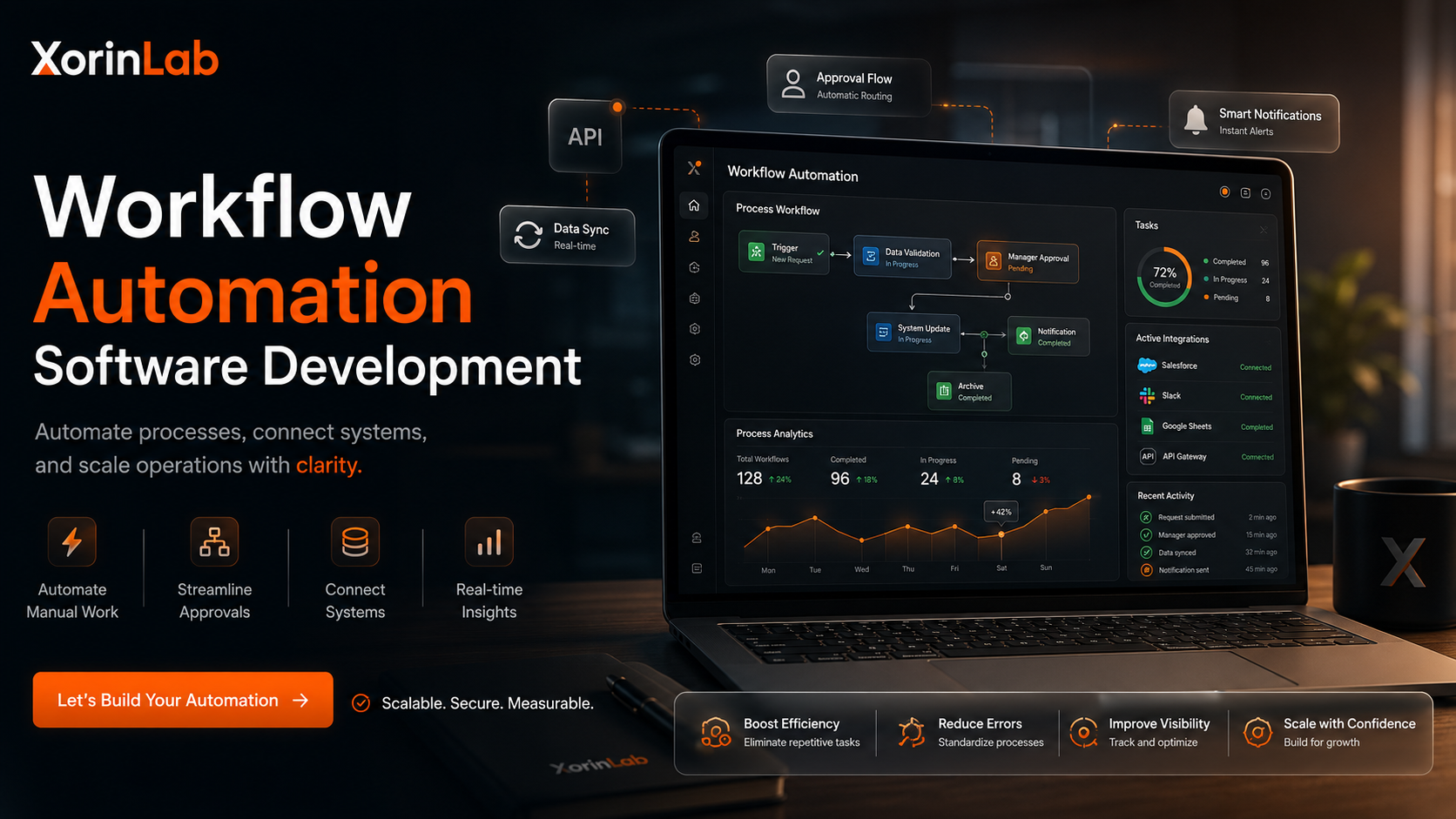
Workflow Automation Software Development
Manual handoffs, disconnected tools, repeated data entry, and unclear approval processes slow teams down and create avoidable errors. Xorin Lab develops custom workflow automation software that turns complex business processes into structured, reliable, and trackable digital workflows.
We design automation around the way your organisation actually operates. That may include routing tasks between departments, triggering actions based on business rules, synchronising data across platforms, generating documents, sending notifications, managing approvals, or escalating overdue work.
Automation Built Around Your Operations
Off-the-shelf automation tools can handle simple tasks, but they often become difficult to manage when workflows involve multiple roles, systems, conditions, and compliance requirements. Custom software gives you greater control over permissions, logic, integrations, reporting, and future expansion.
Our team studies your existing process, identifies bottlenecks, and develops a solution that fits into your current technology environment. The result is a centralised workflow system that helps teams complete work faster while giving managers clear visibility into progress, responsibility, and performance.
What We Can Automate
- Task assignment, routing, and status updates
- Multi-level review and approval processes
- Customer, employee, order, and document workflows
- Data synchronisation between business applications
- Scheduled reports, alerts, reminders, and escalations
- Document generation, validation, and record keeping
- Internal requests, onboarding, and compliance processes
Whether you need to automate one operational process or build a complete workflow management platform, Xorin Lab delivers maintainable software designed for security, usability, and long-term growth.
What We Provide
Workflow Analysis and Planning
We map your current processes, identify delays and repetitive work, and define practical automation opportunities.
Custom Automation Software
We build tailored applications that automate tasks, decisions, handoffs, notifications, and business rules.
System and API Integration
We connect CRMs, ERPs, payment systems, databases, communication tools, and other business platforms.
Approval and Task Management
We create structured approval chains, task queues, ownership rules, deadlines, and escalation workflows.
Workflow Dashboards and Reporting
We provide real-time visibility into workflow status, processing time, bottlenecks, exceptions, and team activity.
Maintenance and Optimisation
We monitor, improve, and expand your automation system as processes, integrations, and business needs evolve.
Feature Points
Standardise processes with clear rules, responsibilities, deadlines, and approval stages.
Minimise data-entry errors by automatically transferring and validating information.
Connect disconnected tools through secure APIs and centralised workflow logic.
Track every task, decision, update, and exception through searchable activity records.
Adapt workflows as teams, business rules, and operational requirements change.
Solutions We Deliver
Business Process Automation Platforms
Centralised platforms for managing recurring operational processes across departments, branches, or business units.
Approval Workflow Systems
Configurable approval systems for purchases, expenses, documents, applications, contracts, and internal requests.
Document Workflow Automation
Solutions for document collection, validation, generation, review, electronic approval, and secure archiving.
Customer and Lead Automation
Automated lead assignment, follow-up reminders, status updates, onboarding tasks, and customer communication workflows.
Employee Operations Automation
Digital workflows for recruitment, onboarding, leave requests, performance reviews, access requests, and offboarding.
Order and Service Fulfilment Automation
Connected workflows that coordinate orders, inventory, payments, service delivery, notifications, and completion tracking.
Our Process
1
Process Discovery
We review your existing workflow, users, systems, documents, decision points, delays, and operational constraints.
2
Automation Blueprint
We define the future workflow, business rules, user roles, integrations, exception handling, and measurable outcomes.
3
UX and Technical Design
We design intuitive screens and establish the architecture, database structure, security model, and integration approach.
4
Development and Integration
We build the automation system, configure workflow logic, and connect it with your required third-party platforms.
5
Testing and Deployment
We test normal and exception scenarios, validate permissions and integrations, migrate required data, and launch the solution.
6
Improvement and Support
We resolve issues, review usage, refine workflows, and add new automation capabilities as your operations develop.
Key Features
- Visual workflow and status tracking
- Role-based access and permissions
- Conditional rules and automated actions
- Multi-stage approvals and escalations
- API and third-party system integrations
- Automated alerts, reminders, and notifications
- Audit logs and activity history
- Custom dashboards and operational reports
Why Choose Us
Process-First Development
We begin by understanding how work moves through your organisation, ensuring the software solves operational problems rather than simply adding another tool.
Custom Business Logic
Your workflow can include specific conditions, approval levels, permissions, exceptions, and calculations that generic platforms may not support.
Integration-Focused Engineering
We design automation to work with your existing systems, reducing data duplication and avoiding unnecessary platform replacement.
Secure and Maintainable Architecture
We use structured development practices to protect sensitive information and make future updates easier to manage.
Built for Continued Improvement
Xorin Lab creates modular systems that can support new workflows, users, integrations, and reporting requirements over time.
Frequently Asked Questions
- What is custom workflow automation software?Custom workflow automation software is an application built around your specific business processes. It automatically manages tasks, decisions, data transfers, approvals, notifications, and system updates based on predefined rules.
- Which business processes can be automated?Processes involving repeated steps, structured decisions, data entry, approvals, notifications, document handling, task assignment, or movement of information between systems are often suitable for automation.
- Can you integrate the software with our existing tools?Yes. We can integrate with systems that provide suitable APIs, webhooks, database access, or supported import and export methods. We assess each platform during discovery to determine the safest and most reliable integration approach.
- Do we need to replace our current software?Not necessarily. A custom automation platform can often connect your existing applications and manage the workflow between them. Replacement is considered only when an existing system creates major technical or operational limitations.
- Can different departments have separate permissions and workflows?Yes. We can create role-based access, department-specific dashboards, separate approval paths, restricted data visibility, and different workflow rules for each user group.
- How do you handle workflow exceptions and failed automations?We design validation rules, retry mechanisms, error notifications, manual review queues, escalation paths, and activity logs so exceptions can be identified and resolved without losing important data.
- Can the workflow be changed after launch?Yes. We structure the system so business rules, approval stages, notifications, roles, and integrations can be updated as your processes evolve. The level of configurability depends on the project requirements.
- How long does workflow automation software development take?The timeline depends on the number of workflows, user roles, integrations, business rules, and reporting requirements. A focused automation solution may take several weeks, while a larger multi-department platform may require a phased development plan.